
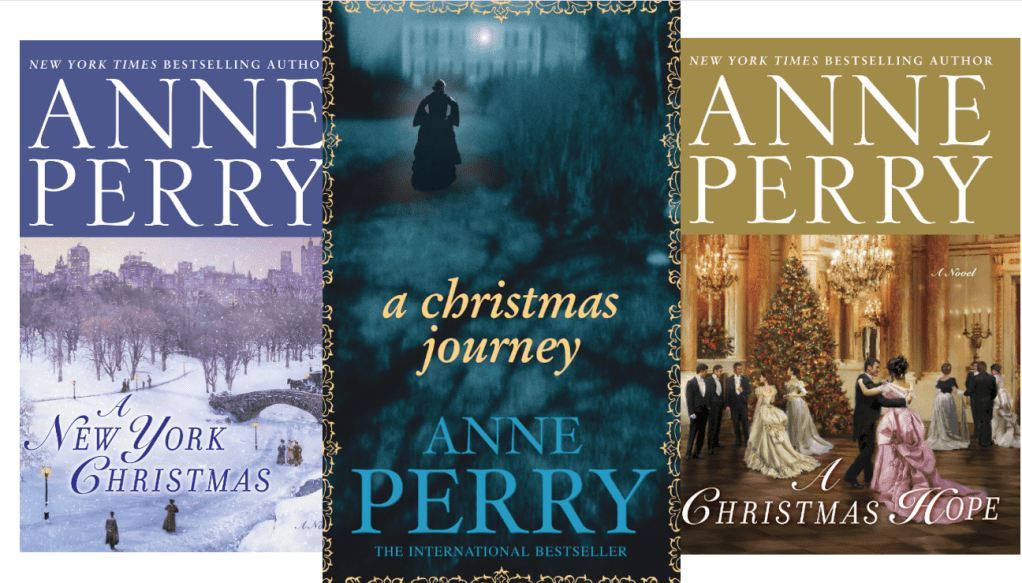
A Christmas Journey, the first in Anne Perry‘s Christmas mystery series, was published in 2003. The last of the 21 novellas was published in 2023.
Our Sleuth: Lady Vespasia Cumming-Gould, 30, a society matron deemed “the most beautiful woman in Europe” by Prince Albert.
Our Setting: It’s the middle of the 19th century when a small group of English aristocrats and others gather at a country house in early December.
The Premise: Perry’s Christmas novellas features lesser-known characters from her two more popular series, the Thomas and Charlotte Pitt historical mysteries and the William Monk historical mysteries. In this case, Vespasia is the great aunt of Charlotte Pitt.
Fresh off the London season, a group of acquaintances gathers at Applecross, a home in rural England. One of the group, the widow Gwendolen Kilmuir, dies by suicide one night after a particularly scathing remark from another widow, Isobel Avie — both have been vying for the attentions of an eligible bachelor among them. The group agrees Isobel must complete a pilgrimage to the home of Gwendolen’s mother, to deliver her suicide note and to seek forgiveness for her role in the death. Vespasia agrees to accompany Isobel on the long journey through the frozen landscapes of Scotland. During the journey, Vespasia comes to understand the forces behind Gwendolen’s death.
My Take: Perry is masterful in her construction of Victorian England, its characters, its society — and its many, many flaws. I read most of her Pitt and Monk books some time ago but only recently discovered the Christmas books, which consist of 21 novellas published between 2003 and 2023. The last book was published posthumously as Perry died in April 2023.
The books do not need to be read in order and I started with A New York Christmas, which features Thomas and Charlotte Pitts’ daughter Jemima, now a young woman visiting New York. I liked it so much that I quickly went back to the beginning of the series and read three more in quick succession. (See the list of books in order here.)
Perry sets these novellas in different locations and features different protagonists in each, though some make repeat appearances. Each wraps up in time for Christmas but it would be a mistake to consider these books as traditional cozies. Perry is unafraid to take on the very real issues of Victorian England, from the poverty of those at the bottom of society to the hypocrisy of those at the top. Men rule absolutely, and women’s lives depend largely on their whims. But Perry also focuses on her protagonists bringing secrets to light, providing a measure of justice in an often cruel world.
Opening Lines:
Lady Vespasia Cumming-Gould hesitated a moment at the top of the stairs. Applecross was one of those magnificent country houses where one descended down a long curved sweep of marble into the vast hall where the assembled guests were gathered awaiting the call to dinner.
First one person, then another looked up. To wait for them all would have been ostentatious. She was dressed in oyster satin, not a shade everyone could wear, but Prince Albert himself had said that she was the most beautiful woman in Europe, with her glorious hair and exquisite bones. It was not a remark that had endeared her to the queen, the more so since it was probably true.
Heads Up: Anne Perry was 15 years into her career as a mystery novelist when journalists uncovered the name she’d been given at birth — Juliet Hulme, one of two New Zealand schoolgirls convicted of murdering the other girl’s mother. Hulme, then 16, served five years and changed her identity after she was released. (Learn more.)
Some readers revolted. Perry told her biographer that she emerged from prison determined to do good, and she joined the Church of Jesus Christ of Latter-Day Saints. As her novellas conclude with Christmas celebrations, there are some references to Christianity. I am not religious and abhor the rise of Christian nationalism in our country, but I did not find Perry to be preachy or oppressive.
 FemaleSleuths.com
Leave a comment